Social Security COLA 2026: Projected 3.2% Increase & Your Payouts

The projected 3.2% Social Security Cost-of-Living Adjustment (COLA) for 2026 aims to help beneficiaries maintain their purchasing power against inflation, directly impacting future monthly payouts for millions of Americans.
For millions of Americans, Social Security benefits represent a cornerstone of their financial security in retirement. Understanding how these benefits are adjusted is crucial. The projected Social Security Cost-of-Living Adjustment (COLA) for 2026, currently estimated at 3.2%, is a topic of significant interest, as it directly influences the purchasing power of retirees, disabled individuals, and survivors. This anticipated increase aims to counteract the effects of inflation, ensuring that the value of your benefits doesn’t erode over time. Delving into the mechanics of COLA, its historical context, and the economic factors that drive these projections can provide invaluable insights for current and future beneficiaries.
This article will explore the intricacies of the 2026 COLA projection, examining how it’s calculated, what it means for your monthly payouts, and the broader economic implications. We’ll also discuss strategies for financial planning in light of these adjustments, helping you navigate your retirement with greater confidence. As the economic landscape continues to evolve, staying informed about Social Security adjustments is more important than ever to safeguard your financial well-being.
Understanding the Social Security COLA: Its Purpose and Mechanics
The Cost-of-Living Adjustment, or COLA, is a vital component of the Social Security system, designed to protect beneficiaries from the erosion of purchasing power due to inflation. Without COLA, the fixed income of retirees and other beneficiaries would steadily lose value, making it harder to afford essential goods and services over time. This annual adjustment is not a bonus or an increase in real benefits; rather, it is an attempt to keep pace with the rising cost of living.
The mechanism behind COLA is tied to inflation data, specifically the Consumer Price Index for Urban Wage Earners and Clerical Workers (CPI-W). This index measures the average change over time in the prices paid by urban wage earners and clerical workers for a market basket of consumer goods and services. The Social Security Administration (SSA) compares the CPI-W from the third quarter of the current year to the third quarter of the last year a COLA was enacted. The percentage increase, if any, determines the COLA for the following year.
The CPI-W and COLA Calculations
The CPI-W is a critical economic indicator chosen because it reflects the spending patterns of working-class Americans, who are often seen as representative of the broader population’s exposure to price changes. The calculation is straightforward yet impactful:
- The average CPI-W for July, August, and September is determined each year.
- This average is then compared to the average CPI-W from the same three months of the last year a COLA was payable.
- The percentage difference becomes the COLA for the upcoming year, rounded to the nearest one-tenth of one percent.
It’s important to note that if there is no increase in the CPI-W, or if it decreases, there is no COLA for that year. This ensures that benefits do not decline, but also means beneficiaries do not receive an increase if inflation is stagnant or negative. The system is designed to be responsive to economic realities, albeit with a slight lag due to the data collection and computation period.
In essence, COLA serves as a financial shield, albeit one that is constantly being tested by economic fluctuations. Its accurate projection and implementation are crucial for maintaining the financial stability of millions, highlighting the importance of understanding how these adjustments are determined and what they signify for personal financial planning.
Projected 3.2% COLA for 2026: What Drives This Forecast?
The projection of a 3.2% Cost-of-Living Adjustment for 2026 is not a random figure; it’s a carefully considered estimate based on current economic trends and inflationary pressures. Several key factors contribute to this forecast, primarily revolving around the trajectory of inflation as measured by the Consumer Price Index for Urban Wage Earners and Clerical Workers (CPI-W).
Economists and analysts closely monitor a range of economic indicators to predict future COLA adjustments. These indicators include energy prices, food costs, housing expenses, and the overall demand for goods and services. A sustained increase in these areas typically signals higher inflation, which in turn leads to a larger COLA. Conversely, a slowdown in price increases or deflationary trends would result in a lower or even zero COLA.
Key Economic Factors Influencing COLA
The primary drivers behind the 3.2% projection for 2026 often include:
- Energy Prices: Fluctuations in crude oil and natural gas prices directly impact transportation and utility costs, which are significant components of the CPI-W.
- Food Costs: Global supply chain issues, weather patterns, and agricultural output can cause significant shifts in food prices, affecting household budgets.
- Housing Expenses: Rent and homeownership costs, including mortgage interest and property taxes, are substantial parts of the inflation calculation.
- Wage Growth: While not directly part of the CPI-W, strong wage growth can contribute to increased consumer demand and, consequently, higher prices.
Analysts use sophisticated models that incorporate these and other economic data points to develop their projections. These models often consider historical inflation rates, global economic outlooks, and domestic fiscal and monetary policies. The 3.2% figure suggests that experts anticipate a continued, albeit potentially moderating, inflationary environment leading up to the COLA determination period in the third quarter of 2025.
It’s crucial to remember that this 3.2% is a projection and not a guarantee. The actual COLA will depend on the CPI-W data from July, August, and September of 2025. However, such forecasts provide valuable insights for beneficiaries to begin planning for their future income. Understanding the underlying economic forces helps paint a clearer picture of potential adjustments to Social Security payouts.
How a 3.2% COLA Impacts Your Social Security Payouts
A projected 3.2% Cost-of-Living Adjustment for 2026 translates directly into an increase in monthly Social Security benefits. For individuals and families relying on these payments, this adjustment can have a noticeable impact on their financial stability and purchasing power. While it’s designed to keep pace with inflation, understanding the practical implications of this percentage increase is key.
Let’s consider a hypothetical example. If your current monthly Social Security benefit is $1,800, a 3.2% COLA would add an additional $57.60 to your payment, bringing your new monthly benefit to $1,857.60. This increase, while seemingly modest on a monthly basis, can accumulate significantly over a year, providing an extra $691.20 annually. For many beneficiaries, this additional income can make a difference in covering rising expenses such as groceries, utilities, and healthcare.

Practical Effects on Beneficiaries
- Maintaining Purchasing Power: The primary goal is to ensure that your benefits can still buy the same amount of goods and services as they did before inflation.
- Budgeting Adjustments: Beneficiaries can factor this anticipated increase into their budget planning for 2026, potentially alleviating some financial strain.
- Healthcare Costs: A portion of the COLA increase might be offset by rising Medicare Part B premiums, which are often deducted directly from Social Security benefits.
It’s important for beneficiaries to monitor their annual Social Security statements, which will detail their new benefit amount once the COLA is officially announced. While the 3.2% projection is a strong indicator, the final figure will be confirmed later in 2025. This adjustment is a testament to the system’s commitment to supporting its recipients, helping them navigate the ever-changing economic landscape.
Ultimately, the 3.2% COLA for 2026 represents a crucial adjustment aimed at bolstering the financial standing of Social Security recipients. By understanding how this increase is calculated and its direct effect on payouts, individuals can better plan their financial futures and adapt to the evolving economic environment.
Historical COLA Trends and Future Outlook
Examining historical Cost-of-Living Adjustments provides valuable context for the projected 3.2% COLA for 2026. The COLA has varied significantly over the decades, reflecting different periods of economic stability, inflation, and even deflation. Understanding these past trends can help beneficiaries anticipate future adjustments and plan accordingly.
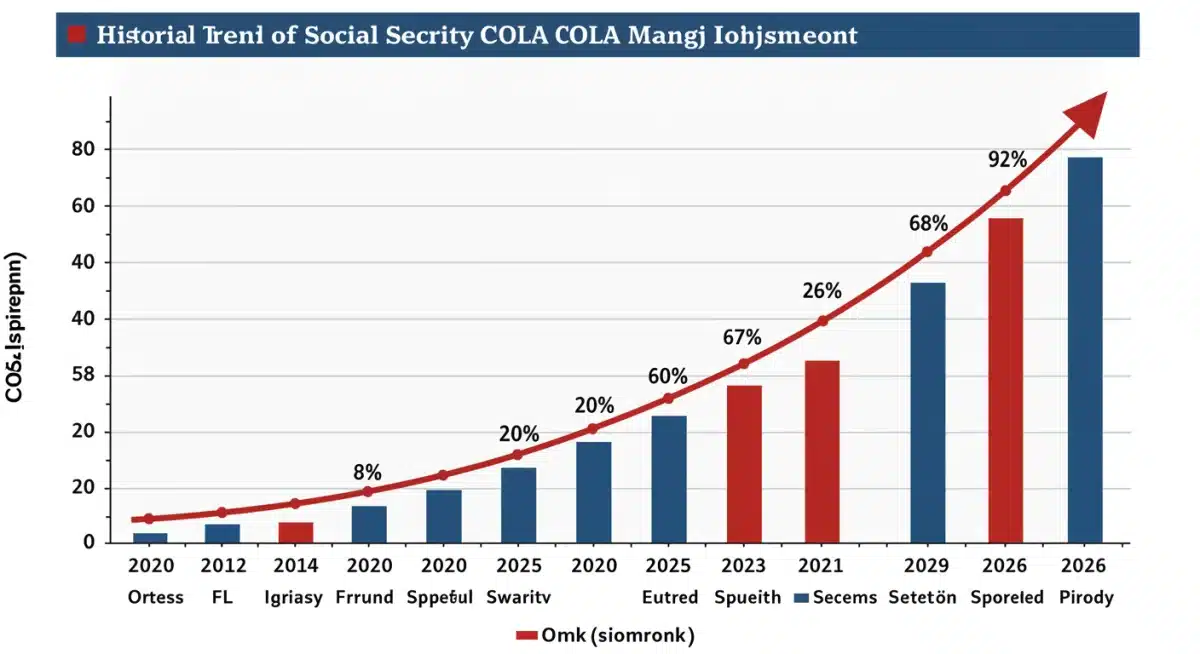
In the early 1980s, for instance, COLA increases were in the double digits due to rampant inflation. More recently, there have been years with zero COLA, particularly during periods of low inflation or economic downturns. The past decade has seen a mix of modest increases and some more substantial adjustments, such as the 5.9% COLA for 2022 and the 8.7% COLA for 2023, which were responses to significant inflationary pressures. These larger increases highlight the responsive nature of the COLA mechanism to real-time economic conditions.
Comparing Recent COLA Adjustments
A look at recent history reveals the dynamic nature of COLA:
- 2020: 1.6%
- 2021: 1.3%
- 2022: 5.9%
- 2023: 8.7%
- 2024: 3.2%
The projected 3.2% for 2026, if realized, would be consistent with the 2024 adjustment, suggesting a potential stabilization of inflation at a moderate level after the spikes of 2022 and 2023. This trend indicates that while inflation remains a factor, it may not be as volatile as in the immediate post-pandemic years.
Looking ahead, the future outlook for COLA depends heavily on global and domestic economic conditions. Factors such as supply chain resilience, geopolitical stability, energy market dynamics, and central bank policies will all play a role. Experts often project that while we may not see the exceptionally high COLA percentages of recent years, consistent, moderate adjustments are likely to continue as economies strive for stable growth.
Historical data confirms that the Social Security system is built to adapt, ensuring that benefits generally keep pace with the cost of living over the long term. This adaptive mechanism is crucial for the financial security of millions of Americans.
Strategies for Financial Planning with the 2026 COLA in Mind
Effective financial planning is paramount for Social Security beneficiaries, and factoring in the projected 3.2% COLA for 2026 can help optimize retirement budgets. While the COLA aims to preserve purchasing power, proactive planning can maximize the impact of this adjustment and address other financial considerations such as healthcare costs and taxes.
One primary strategy is to integrate the anticipated COLA into your annual budget review. By adding the estimated increase to your expected income, you can better allocate funds for essential expenses, discretionary spending, or even savings. This foresight allows for a more stable financial outlook, preventing unexpected shortfalls or enabling new financial goals.
Optimizing Your Retirement Budget
Consider these practical steps to make the most of the projected COLA:
- Review Your Expenses: Periodically assess your spending habits to identify areas where you can save or reallocate funds.
- Account for Medicare Premiums: Remember that Medicare Part B premiums are often deducted directly from Social Security benefits and can increase annually, potentially offsetting some of your COLA.
- Tax Implications: Understand how your Social Security benefits might be taxed, especially if your combined income exceeds certain thresholds. A higher COLA could potentially push you into a taxable bracket or increase your existing tax liability.
Beyond budgeting, consider how the COLA might influence your investment strategy. If you have other income sources or investments, a predictable increase in Social Security benefits can provide a stable base, allowing for potentially more aggressive or conservative investment approaches elsewhere, depending on your risk tolerance and financial goals. Consulting with a financial advisor can offer personalized guidance on how to best integrate your Social Security income with your broader financial portfolio.
The 2026 COLA, while modest, is a consistent reminder that proactive financial management is key to a secure retirement. By understanding its impact and adjusting your financial strategies accordingly, you can ensure your Social Security benefits continue to support your lifestyle effectively.
The Broader Economic Implications of COLA Adjustments
The Social Security Cost-of-Living Adjustment (COLA) extends beyond individual beneficiaries, carrying significant broader economic implications. A projected 3.2% COLA for 2026, for instance, affects not only the purchasing power of millions but also influences consumer spending, government budgets, and the overall economic landscape. These adjustments are a barometer of inflationary pressures and a mechanism for economic stabilization.
From a macroeconomic perspective, COLA injections represent billions of dollars flowing into the economy. This increased spending by a large segment of the population can stimulate demand for goods and services, supporting businesses and employment. However, if not balanced with productivity growth, it could also contribute to further inflationary pressures, creating a cyclical challenge for economic policymakers.
Impact on Government Finances and Inflation
The financial implications for the government are substantial:
- Social Security Trust Funds: Each COLA increase draws more funds from the Social Security trust funds, highlighting the importance of the system’s long-term solvency.
- Federal Budget: Increased payouts contribute to federal expenditures, which can impact the national budget and debt levels, especially in years with large COLA adjustments.
- Inflationary Feedback Loop: While COLA is designed to counteract inflation, significant increases could, in theory, contribute to an inflationary feedback loop if not managed carefully by broader economic policy.
Moreover, COLA adjustments serve as an important indicator for other benefit programs that may be linked to Social Security or inflation indices. Many private pension plans and other government benefits also incorporate similar cost-of-living clauses, meaning a COLA announcement can have a ripple effect across various income streams for seniors and other vulnerable populations. This interconnectedness underscores the systemic importance of the annual COLA determination.
In conclusion, the 3.2% COLA projection for 2026 is more than just a number for beneficiaries; it’s a critical economic lever. It reflects current economic conditions, influences future spending patterns, and poses challenges and opportunities for fiscal policy. Understanding these broader implications provides a more complete picture of Social Security’s role in the national economy.
Preparing for Future COLAs: What Beneficiaries Should Know
As beneficiaries look ahead, preparing for future Cost-of-Living Adjustments (COLAs) is an ongoing process that involves staying informed and proactively managing personal finances. The projected 3.2% COLA for 2026 offers a glimpse into potential future adjustments, emphasizing the need for continuous financial vigilance. While the COLA helps maintain purchasing power, it’s not a substitute for comprehensive financial planning.
One key aspect of preparation is to regularly review official communications from the Social Security Administration (SSA). The SSA typically announces the official COLA for the upcoming year in October, based on the CPI-W data from the third quarter. This official announcement will confirm the exact percentage and its effective date, usually in December for benefits paid in January.
Key Actions for Beneficiaries
To effectively prepare for future COLAs and manage your benefits:
- Stay Informed: Follow economic news, particularly reports on inflation and the CPI-W, to anticipate potential COLA changes.
- Monitor Your Statements: Regularly check your Social Security statements for updated benefit amounts and any deductions, such as Medicare premiums.
- Diversify Income Sources: Relying solely on Social Security can be risky. Consider other retirement savings, investments, or part-time work to supplement your income.
- Consult Experts: A financial advisor specializing in retirement planning can provide tailored advice on how to integrate Social Security benefits with your overall financial strategy.
It’s also prudent to consider the long-term solvency of the Social Security system. While COLA ensures benefits keep pace with inflation, ongoing discussions about the system’s financial health can lead to legislative changes that might affect future benefits. Staying aware of these policy debates is another layer of preparation, allowing beneficiaries to advocate for their interests and adjust their plans if necessary.
By taking a proactive approach to understanding and preparing for COLA adjustments, beneficiaries can confidently navigate their financial futures, ensuring their Social Security benefits continue to provide essential support. The 2026 projection serves as a valuable reminder of the dynamic nature of these benefits and the importance of ongoing financial awareness.
| Key Point | Brief Description |
|---|---|
| 2026 COLA Projection | Estimated 3.2% increase in Social Security benefits for 2026, aiming to counteract inflation. |
| COLA Calculation | Based on the Consumer Price Index for Urban Wage Earners and Clerical Workers (CPI-W) from Q3. |
| Impact on Payouts | Directly increases monthly benefit amounts, helping beneficiaries maintain purchasing power. |
| Financial Planning | Integrate COLA projections into budgeting, consider Medicare premiums and tax implications. |
Frequently Asked Questions About COLA
The primary purpose of the Social Security COLA is to protect the purchasing power of beneficiaries’ benefits. It ensures that the value of their monthly payments keeps pace with inflation, allowing them to afford essential goods and services despite rising costs over time.
The COLA is calculated based on the Consumer Price Index for Urban Wage Earners and Clerical Workers (CPI-W). The Social Security Administration compares the average CPI-W from the third quarter (July, August, September) of the current year to the same period of the last year a COLA was paid.
No, the 3.2% COLA for 2026 is currently a projection. The final, official COLA will be announced by the Social Security Administration in October 2025, after the CPI-W data for the third quarter of 2025 has been fully compiled and analyzed.
A COLA increase can sometimes be partially offset by rising Medicare Part B premiums. These premiums are often deducted directly from Social Security benefits, and their annual adjustments can consume a portion of the COLA, impacting the net increase in your monthly payout.
Beneficiaries should stay informed about economic trends, regularly review their Social Security statements, and incorporate COLA projections into their financial planning and budgeting. Diversifying income sources and consulting a financial advisor can also enhance preparation for future adjustments.
Conclusion
The projected 3.2% Social Security Cost-of-Living Adjustment (COLA) for 2026 stands as a critical element in the financial lives of millions of Americans. It underscores the ongoing effort to shield beneficiaries from the erosive forces of inflation, aiming to ensure their hard-earned benefits retain their value. While a projection, this figure provides a vital benchmark for individuals to begin assessing their future financial landscape, prompting necessary adjustments to budgeting and long-term planning. Understanding the mechanics of COLA, its economic drivers, and its historical context empowers beneficiaries to navigate their retirement years with greater confidence and foresight. As the economic environment continues its dynamic shifts, staying informed about these adjustments remains paramount for securing one’s financial well-being and making the most of Social Security benefits.