Ultimate 6-Month Study Plan for Standardized Tests 2026

Are you staring down the barrel of a major standardized test in 2026? Whether it’s the SAT, ACT, GRE, GMAT, MCAT, LSAT, or another crucial exam, the thought of preparing can be overwhelming. But what if we told you that with a well-structured, ultimate 6-Month Study Plan, you could not only conquer your fears but also significantly boost your scores? This comprehensive guide offers practical solutions and a detailed roadmap to help you navigate the complexities of test preparation, ensuring you’re fully equipped and confident on test day. The key to success isn’t just about studying hard; it’s about studying smart, consistently, and strategically. Let’s dive into how you can make the next six months your most productive study period yet.
Why a 6-Month Study Plan is Your Secret Weapon
Many students make the mistake of cramming in the last few weeks or months leading up to a standardized test. While some might see marginal gains, this approach rarely yields optimal results. A 6-Month Study Plan, however, offers a multitude of advantages that set you up for true success:
- Ample Time for Content Mastery: Standardized tests often cover a vast array of subjects and concepts. Six months provides sufficient time to revisit foundational knowledge, delve into complex topics, and ensure a deep understanding of all required material.
- Effective Skill Development: These tests aren’t just about what you know; they’re about how you apply that knowledge under pressure. A longer preparation period allows you to develop crucial test-taking skills such as time management, critical thinking, problem-solving, and strategic guessing (when appropriate).
- Reduced Stress and Burnout: Spreading your study load over six months prevents the intense pressure and burnout associated with last-minute cramming. You can maintain a healthier work-life balance, leading to better retention and overall well-being.
- Identification and Fortification of Weaknesses: With a 6-Month Study Plan, you have the luxury of identifying your weak areas early on. This allows for targeted practice and focused remediation, turning your weaknesses into strengths.
- Multiple Practice Test Opportunities: Regular practice tests are invaluable for tracking progress, familiarizing yourself with the test format, and building stamina. Six months gives you enough time to take several full-length practice tests and thoroughly review your performance.
- Adaptability and Flexibility: Life happens. A longer study period means you have built-in flexibility to adjust your schedule for unexpected events, illness, or academic demands without derailing your entire preparation.
Embracing a comprehensive 6-Month Study Plan is not just about passing an exam; it’s about building confidence, developing effective study habits that will serve you throughout your academic and professional life, and ultimately achieving your highest potential on test day. This structured approach is a practical solution to what can often feel like an insurmountable challenge.
Phase 1: The Foundation (Months 1-2) – Laying the Groundwork
Month 1: Assessment and Goal Setting
The first step in any successful 6-Month Study Plan is understanding where you stand and where you want to go. This month is dedicated to assessment, planning, and gathering resources.
Week 1: Initial Diagnostic Test
- Take a Full-Length Practice Test: Simulate actual test conditions as closely as possible. This initial diagnostic will provide a baseline score and highlight your current strengths and weaknesses across all sections.
- Analyze Results Thoroughly: Don’t just look at the score. Identify specific question types you struggled with, content areas where your knowledge is lacking, and sections where time management was an issue.
- Research Test Structure: Familiarize yourself with the format, scoring, types of questions, and timing of the specific standardized test you’re taking.
Week 2: Set SMART Goals and Create a Master Schedule
- Define Your Target Score: Based on your diagnostic and research into college/program requirements, set a realistic yet ambitious target score.
- Establish Weekly Study Hours: Determine how many hours you can realistically dedicate to studying each week. Aim for consistency rather than sporadic long sessions.
- Outline a Master Schedule: Create a high-level overview of your 6-Month Study Plan, allocating blocks of time for content review, practice, and rest.
- Gather Resources: Acquire official test prep books, reputable online platforms, flashcards, and any other materials you’ll need.
Weeks 3-4: Content Review & Foundational Skills
- Begin Broad Content Review: Start with the most fundamental concepts in subjects where your diagnostic showed weaknesses. For example, if it’s the SAT/ACT, start with basic algebra, geometry, and grammar rules.
- Review Test-Specific Strategies: Begin to learn general strategies for each section (e.g., reading comprehension techniques, essay writing structures, quantitative problem-solving approaches).
- Vocabulary Building (if applicable): Dedicate a small portion of daily study to vocabulary if your test includes a significant verbal component.
Month 2: Deep Dive into Content and Initial Practice
Building on the foundation, Month 2 of your 6-Month Study Plan involves more focused content review and the introduction of timed practice.
Weeks 5-6: Targeted Content Review
- Focus on Key Areas: Based on your diagnostic, dedicate more time to content areas that are frequently tested and where you need the most improvement.
- Utilize Diverse Resources: Don’t rely on just one textbook. Supplement with online videos, articles, and different practice questions to gain multiple perspectives.
- Active Learning Techniques: Don’t just passively read. Summarize, teach concepts to someone else, create flashcards, and solve practice problems as you learn.
Weeks 7-8: Section-Specific Practice & Time Management
- Timed Section Practice: Start doing timed practice sections. This helps you get used to the pace required for each part of the test.
- Review Mistakes Systematically: For every incorrect answer, analyze why you got it wrong. Was it a content gap, a careless error, or a misunderstanding of the question?
- Refine Time Management: Experiment with different strategies during timed practice to find what works best for you. Learn when to skip difficult questions and how to allocate your time effectively.
Phase 2: Skill Development & Intensive Practice (Months 3-4) – Building Momentum
Month 3: Strategic Drills and Weakness Targeting
Month 3 of your 6-Month Study Plan is all about honing your skills and directly addressing persistent weaknesses.
Weeks 9-10: Advanced Content & Question Types
- Tackle Advanced Concepts: Move on to more complex topics within each subject area.
- Deconstruct Difficult Questions: Spend time understanding the logic behind challenging questions and the common traps test-makers set.
- Practice Specific Question Types: If you consistently struggle with certain question formats (e.g., inference questions in reading, data interpretation in science), dedicate specific practice sessions to them.
Weeks 11-12: Second Full-Length Practice Test & Strategy Adjustment
- Take Another Full-Length Practice Test: This is a crucial checkpoint in your 6-Month Study Plan. Compare your score to your diagnostic and target score.
- Detailed Performance Analysis: Beyond just the score, analyze your progress in each section, your time management, and the types of errors you’re still making.
- Adjust Your Study Plan: Based on the results, fine-tune your schedule. Reallocate more time to areas where you’re still lagging.
Month 4: Mastering Pacing and Endurance
This month focuses on building the stamina and mental fortitude required for a long, challenging exam.
Weeks 13-14: Focused Practice & Pacing Drills
- Timed Section Practice (Increased Frequency): Increase the frequency of timed section practice to reinforce pacing.
- Simulate Test Breaks: During your practice, take breaks that mimic the actual test day schedule to get used to the rhythm.
- Review and Re-review: Continually revisit previously covered content and common error types. Spaced repetition can be incredibly effective here.
Weeks 15-16: Test Strategies & Error Log Review
- Refine Test-Taking Strategies: Perfect your approach to different question types, including elimination strategies, process of elimination, and when to guess.
- Maintain an Error Log: If you haven’t already, start an error log. Document every question you get wrong, why you got it wrong, and the correct solution. Review this log weekly. This is a practical solution for identifying patterns in your mistakes.
- Address Mental Blocks: If certain topics or question types consistently cause anxiety, spend extra time breaking them down.
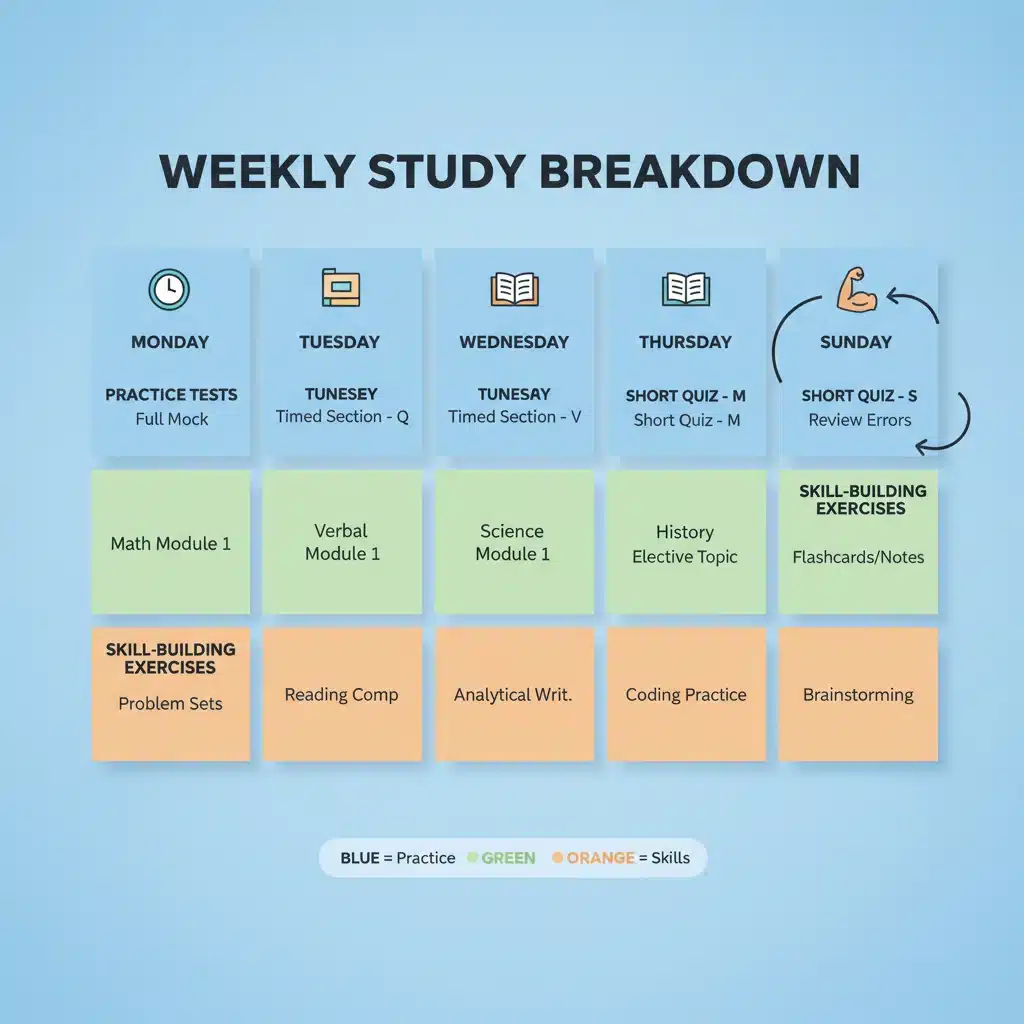
Phase 3: Refinement & Peak Performance (Months 5-6) – The Home Stretch
Month 5: Intensive Review and Full-Length Simulations
The penultimate month of your 6-Month Study Plan is about solidifying all your learning and simulating the test experience as much as possible.
Weeks 17-18: Comprehensive Content Review & Practice Test Analysis
- High-Level Content Review: Go through all content areas, focusing on recalling key facts, formulas, and concepts.
- Third Full-Length Practice Test: Take another full-length diagnostic. This should show significant improvement. Analyze it meticulously.
- Compare and Contrast: Look at your performance across all three practice tests to identify trends and areas that still need attention.
Weeks 19-20: Targeted Drills & Strategy Optimization
- Focused Drills on Persistent Weaknesses: Dedicate specific study blocks to the few remaining topics or question types that still challenge you.
- Master Pacing: By now, your pacing should be almost automatic. Work on shaving off seconds where possible without sacrificing accuracy.
- Review Error Log: Spend significant time reviewing your error log to ensure you don’t repeat past mistakes.
Month 6: The Final Push and Test Day Readiness
The final month of your 6-Month Study Plan is critical for consolidating knowledge, building confidence, and preparing for the actual test day.
Weeks 21-22: Final Practice Tests & Mental Preparation
- Fourth Full-Length Practice Test: Take your final full-length practice test. Aim for your target score.
- Simulate Test Day Conditions: Take this practice test at the exact time of day your actual exam will be held. Eat the same breakfast, wear comfortable clothes, and minimize distractions.
- Review All Practice Tests: Go back through all the practice tests you’ve taken, focusing on the questions you got wrong or found challenging.
- Positive Affirmations & Visualization: Start incorporating mental preparation. Visualize yourself performing well and feeling confident on test day.
Week 23: High-Yield Review & Logistics
- High-Yield Content Review: Focus on reviewing the most frequently tested concepts and formulas. Don’t try to learn anything new.
- Review Basic Strategies: Quickly refresh your memory on general test-taking strategies.
- Confirm Test Day Logistics: Double-check the test location, time, required identification, and permitted items. Pack your bag.
- Prioritize Sleep: Ensure you are getting adequate sleep every night.
Week 24 (The Week Before the Test): Tapering and Self-Care
- Light Review Only: Do not cram. Engage in light review of flashcards or your error log. Avoid any new, challenging material.
- Focus on Well-being: Prioritize sleep, healthy eating, light exercise, and relaxation.
- Avoid Burnout: This is a crucial time to prevent mental fatigue. Trust in your 6-Month Study Plan.
- Final Check: Confirm all test day essentials are ready.
Practical Solutions for Common Challenges
Even with the best 6-Month Study Plan, you’re bound to encounter hurdles. Here are some practical solutions:
Challenge 1: Lack of Motivation
- Solution: Set Small, Achievable Goals: Break down your study plan into smaller, manageable tasks. Checking off these mini-goals can provide a sense of accomplishment and boost motivation.
- Solution: Reward System: Implement a small reward system. After completing a week of consistent study, treat yourself to something enjoyable (a movie, a favorite meal, a short break).
- Solution: Study Buddy/Group: A study partner or group can provide accountability and make studying more engaging.
- Solution: Remind Yourself of Your ‘Why’: Keep your ultimate goal (e.g., getting into a specific university, career advancement) at the forefront of your mind.
Challenge 2: Forgetting Material
- Solution: Spaced Repetition: Review material at increasing intervals. Use flashcard apps or create your own system.
- Solution: Active Recall: Instead of re-reading notes, quiz yourself. Try to recall information from memory before checking your notes.
- Solution: Teach the Material: Explaining a concept to someone else (or even an imaginary audience) is one of the most effective ways to solidify your understanding.
Challenge 3: Test Anxiety
- Solution: Mindfulness and Meditation: Incorporate short mindfulness exercises or meditation into your daily routine to calm your mind.
- Solution: Deep Breathing Exercises: Practice deep breathing techniques that you can use on test day to manage sudden spikes of anxiety.
- Solution: Positive Self-Talk: Challenge negative thoughts and replace them with positive affirmations.
- Solution: Exposure Therapy (Practice Tests): The more you simulate the test environment, the less intimidating the actual test day will be.

Challenge 4: Time Management Issues
- Solution: Pomodoro Technique: Work in focused 25-minute intervals, followed by a 5-minute break. This can improve concentration and prevent burnout.
- Solution: Prioritize Tasks: Use a planner or a digital tool to prioritize your study tasks. Focus on high-impact activities first.
- Solution: Eliminate Distractions: Turn off notifications, put your phone away, and find a quiet study environment.
Key Habits for Success Throughout Your 6-Month Study Plan
- Consistency is King: Regular, even short, study sessions are more effective than sporadic marathon sessions. Stick to your 6-Month Study Plan as much as possible.
- Prioritize Sleep: Adequate sleep is crucial for memory consolidation and cognitive function. Don’t sacrifice sleep for extra study time.
- Healthy Diet and Exercise: Fuel your brain with nutritious food and incorporate regular physical activity to reduce stress and improve focus.
- Take Regular Breaks: Step away from your studies to prevent mental fatigue. Short breaks can significantly improve productivity.
- Stay Hydrated: Dehydration can lead to fatigue and reduced concentration. Keep water nearby.
- Seek Support: Don’t hesitate to ask for help from teachers, tutors, or study groups if you’re struggling with a concept.
- Maintain a Positive Mindset: Believe in your ability to succeed. Your attitude can significantly impact your performance.
Conclusion: Your Path to Test Day Confidence with a 6-Month Study Plan
Embarking on a 6-Month Study Plan for standardized tests in 2026 is an investment in your future. It’s a journey that requires discipline, strategic thinking, and resilience, but the rewards are immeasurable. By following this detailed roadmap, from initial assessment and goal setting to intensive practice and final review, you are not just preparing for an exam; you are building a foundation of knowledge and skills that will serve you far beyond test day.
Remember, this plan is a guide. Feel free to adjust it to fit your unique learning style, pace, and the specific requirements of your standardized test. The most effective 6-Month Study Plan is one you can consistently adhere to and that addresses your individual needs. Stay focused, stay motivated, and trust the process. With these practical solutions and a dedicated approach, you will walk into your 2026 standardized test with confidence, ready to achieve the scores you deserve. Your hard work and strategic preparation will undoubtedly pay off.